








The Unseeing Village: An Interactive Story
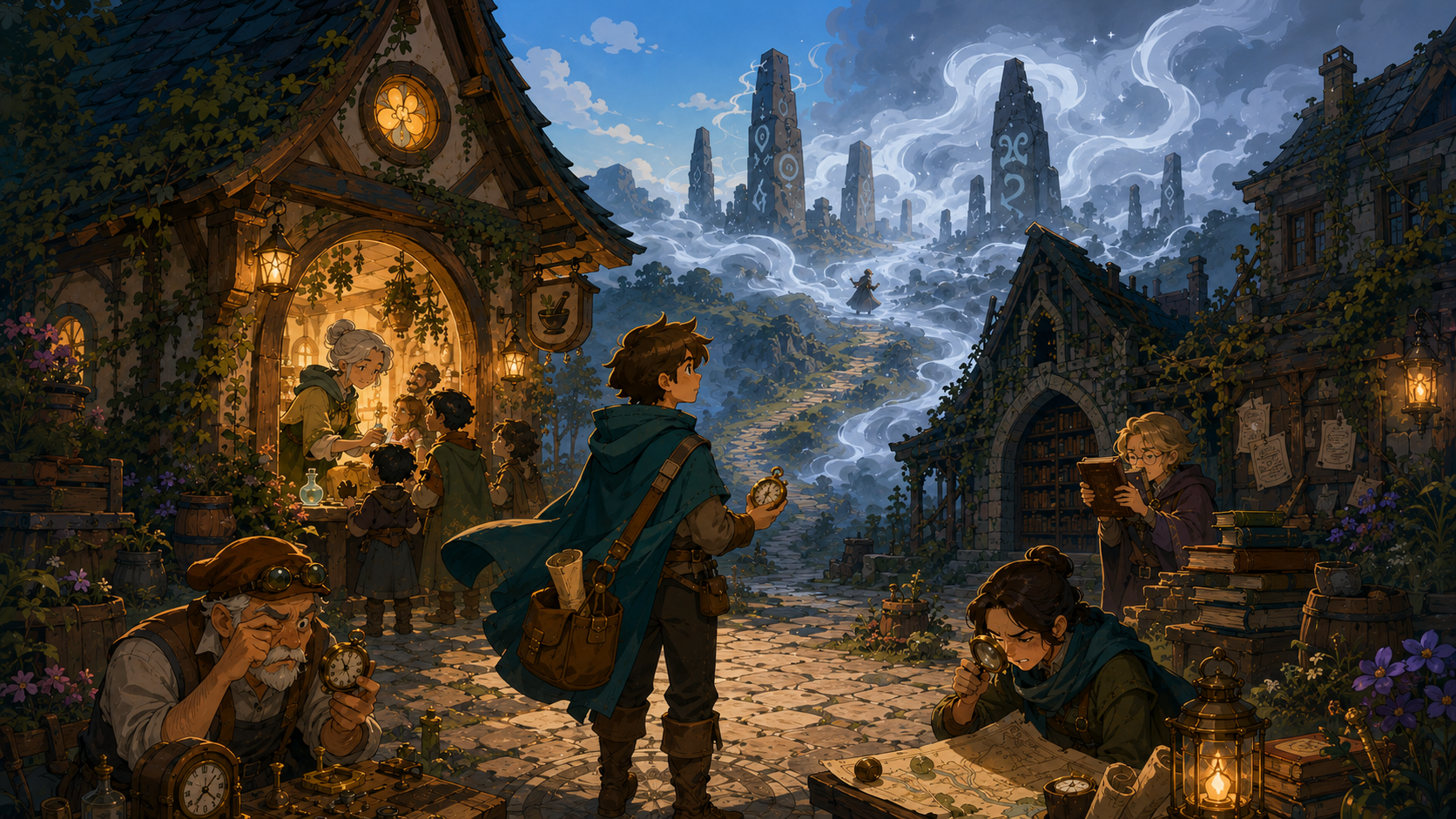
The village of Maculara no longer feels like it has heart. Doors stay shut. Creations sit unfinished. Villagers walk with one hand against a wall, a fence, or the shoulder of a companion. The mist hasn’t reached the center of the village, but its effects are already felt by everyone.
The blacksmith squints at the clock above his workshop. The librarian holds a book inches from her face. The cartographer stares at a page filled with lines that aren’t straight.
The cleric joins you beneath the town hall lantern. She carries a bag packed with notes, sketches, and names.
“The Blindness hasn’t changed every pair of eyes in the same way,” she says, glancing toward the villagers nearby. “Even if the legendary treasure is real, it cannot be used as a common remedy. Each person’s current sight, eye measurements, and prescription will still need individual attention.”
“We need a clue before you leave. Three places deserve our attention, and the Blindness keeps moving.”
Across from you is her cottage, crowded with waiting families. Farther north, the mist gathers around a group of stones older than the village itself. The bronze compass begins to feel warm in your hand.
Where will you begin your search?
The cottage smells of dried herbs and lamp oil. Sketches of eyes cover one wall, while open books and individual vision records fill a long oak table. Families sit close together, speaking in low voices as the cleric moves from one villager to the next.
When she sees the bronze compass, she clears a place at the table..
“Their descriptions can guide our questions, but they cannot replace an examination, current measurements, or a prescription,” she says. “The first clue could rest with the people, the records, or the mist itself.”
Where will you look first?
The librarian waits beneath the cracked stone arch of the library. She can no longer read the faded titles above the doors, yet she remembers every room inside.
Dust hangs in the tall reading hall. Sunlight falls across shelves packed with maps, legends, and village records. Somewhere above, a loose shutter knocks against the wall.
“The treasure appears in three old texts,” she says. “One rests on the public shelves. One survives in memory. One was sealed upstairs.”
Where will you begin?
The Blindness curls across the northern field in slow waves. Ancient stones rise from the grass, half hidden inside the mist. Birds circle above the boundary but refuse to cross it.
The compass needle shakes as you step closer.
Where will you begin?
You sit beside the families and ask each person to describe the change in their sight. Their answers fall into separate groups. Some speak of distant blur. Some struggle with close work. Others report bent lines or doubled edges.
The cleric records every description without assigning a remedy. Similar complaints don’t mean identical prescriptions, and the cause of the vision change must be examined before anyone receives corrective lenses.
Three voices rise above the rest. A miller keeps pointing north. A child grips a metal charm. The blacksmith recalls a sound beneath the tower.
Whose account will you follow?
You pull the first ledger closer. Its leather cover has cracked with age, and several pages have been repaired with thin strips of cloth. The earliest entries date back more than a century. The newest were written only hours ago.
Several entries carry blue marks in the margins. The marks appear beside certain symptoms, names, and locations.
“Those marks began after the Blindness reached the northern road,” the cleric says.
Which clue will you follow?
The dust near the window glitters like frost, though the glass feels warm. Small rings form inside it when sunlight crosses the sill. A thin trail runs from the frame toward the herb garden outside.
The cleric places a clean vial and a magnifying lens on the table.
Which clue will you inspect?
Three books mention the Clear Sight Treasure. One is a founder’s chronicle. One is a route atlas. One survived a fire that destroyed half the eastern wing.
Each book points north, though none shows a complete road.
Which book will you open?
The librarian closes her eyes and recites fragments from childhood stories. One tale speaks of glass-thin circles stored beneath a mountain. Another names three guardians, each watching a separate road.
Her memory holds clues that no surviving page records.
Which memory will you follow?
A rope blocks the staircase, and several steps have cracked. The archive door stands open at the top, swaying in a cold draft.
Inside, map cabinets, floor mosaics, and broken display cases wait beneath sheets of dust.
Where will you search?
Each stone carries a worn carving filled with dust. The stones form a wide curve around one northern hill.
One stands taller than the rest. One has fallen. One bears symbols for a tree, a tower, and a river.
Which clue will you study?
Three trails cross the boundary. Raven feathers lie beside tiny prints. Fox tracks pass through a thorn hedge. Goat hoof marks climb toward the ridge.
Each trail leads away from the village and into thicker air.
Which trail will you follow?
As daylight fades, blue lights drift inside the mist. They gather near three points across the northern field. A low hum rises beneath the wind.
The Blindness changes shape whenever the last sunlight touches it.
Which sign will you follow?
The miller says distant rooftops vanished into haze, yet a blue flash remained sharp near the northern hill. Two other villagers remember the same flash from separate streets.
Their descriptions do not line up until you place a village map across your knees.
What will you do next?
The child says her mother’s face has become a pale blur from across the room. She turns the charm in her fingers. It is shaped like an open eye, with three short lines beneath it.
She found it near a dry well, yet fear has tangled her memory.
How will you respond?
The blacksmith remembers a low hum under the tower before the mist appeared. A line raced across the ground, then vanished north of the square.
He taps the table in a slow rhythm, trying to recall the tone.
Which step will you take?
You arrange the reports into three groups. Distant blur forms one pile. Warped or doubled lines form another. Trouble shifting focus between near and far forms the third.
Each pile carries a separate symbol: a circle, a crossed oval, or three linked rings. Beneath the final sheet lies a faded village drawing with three blue lines running north.
What will you do with the pattern?
A thin strip of paper clings to the binding. It carries half a sentence and the lower curve of an eye symbol. The missing sheet appears to have been removed with care, not torn in haste.
Dust beneath the desk shows that someone searched this spot before you.
Where will you search?
The open-eye symbol appears beside names tied to old road guards. Inside each pupil are three short lines. The same families once watched the forest, tower, and river routes north of Maculara.
One living descendant waits near the door, listening closely.
How will you continue?
The dust spins inside the vial and settles into three narrow bands. Each band glows when the bronze compass points north.
The cleric opens a cabinet filled with older samples from earlier outbreaks.
What will you try?
Through the lens, the rings resemble overlapping circles drawn on an old optical chart. At one angle, they break apart. At another, they form an open eye.
Faint letters sit between the circles.
How will you reveal them?
The line crosses the herb garden, slips beneath a stone bench, and ends at a patch of dark soil. Wind begins lifting the dust from the leaves.
The cleric joins you with chalk and a hand shovel.
What will you do?
The chronicle says the treasure was built for eyes with different correction needs. A verse follows the account, written in uneven lines.
The librarian hears a pattern in the wording, though the meaning remains hidden.
How will you read it?
The atlas shows three northern routes ending at the same blank circle. Later maps remove all three, replacing them with empty hills.
A thin blue thread has been stitched along one page edge.
What will you inspect?
Most of the cover is blackened, yet the clasp remains intact. An open eye is stamped into the metal. The pages smell of smoke even after all these years.
Something rattles inside the spine.
How will you open the book?
Her grandmother spoke of one guardian in the forest, one in a tower, and one beside an underground river. Each carried a token marked with an eye.
The librarian remembers one detail from each guardian, though the order is uncertain.
How will you piece it together?
She remembers the rhythm but not every word. You tap the pattern on the table until the final line returns to her.
The bronze compass vibrates with each fourth beat.
What will you do with the restored line?
The sketchbook contains trees, bells, rivers, and one enormous eye above a hill. A faint line runs from the eye to a stone bridge.
The librarian remembers copying the drawing during a school walk.
Which detail will you study?
The latch is rusted shut. You work it loose and uncover parchment rolls tied with blue thread.
The oldest rolls feel brittle, while newer ones carry fresh handling marks.
Which action will you take?
The mosaic shows three roads circling a blue eye. Several tiles are missing near the center, leaving a shape similar to the bronze compass.
A locked drawer sits beneath the nearest display case.
How will you restore the image?
The loft holds rolled banners, broken cases, and a cracked brass telescope. A narrow window faces the northern hills.
The floorboards creak beneath your weight.
What will you inspect?
Beneath the dust, an open eye appears above three branching lines. The pupil has a hollow space shaped like the bronze compass.
The stone feels warm despite the cold mist.
What will you do?
The stones do not form a border. They form an arc around one hill. Small spaces between them line up with old paths hidden beneath grass.
The mist grows thicker as you walk the curve.
How will you trace it?
The carvings show a tree, a tower, and a river. Each symbol faces north. A fourth center stone lies buried beneath weeds.
Old road workers gather nearby, watching your search.
Which step will you take?
The feathers lead to a dead tree hung with blue thread. A metal disk rests inside a hollow. A raven watches from a branch above.
The thread has been tied into small knots.
What will you inspect?
The tracks pass through a thorn hedge and stop at an opening beneath an uprooted tree. Cold air flows from the darkness below.
The roots hold a metal token half hidden in the soil.
How will you continue?
The hoof marks climb a rocky slope where the mist thins. A shepherd’s bell rings somewhere above, followed by a weak call.
The path splits near a sharp ledge.
What will you do?
The curved surface brings the lights into sharper form. They resemble a tree, a tower, and a river. When the bowl moves, the shapes begin to overlap.
The cartographer stands nearby, straining to see.
How will you read the shapes?
The slope is steep, and mist hides loose stones. From the top, the blue lights line up across the field in a pattern invisible from below.
A narrow ledge reaches farther north.
What will you do?
The tone rises and falls in a repeating pattern. The bronze compass echoes it in your hand. Three pauses divide each cycle.
The sound grows stronger near midnight.
How will you answer it?
You press the map flat across the cleric’s table and mark every place where a villager saw the blue flash. At first, the points look scattered. Once the final mark is added, they curve around the northern edge of Maculara like the outline of an open eye.
The cleric places the bronze compass at the center of the shape. Its needle turns toward a road missing from newer maps. An elderly farmer recognizes the route as the Old North Way, abandoned after a landslide buried part of it. The clue now points beyond the village, toward the ridge where the hidden treasure is said to rest.
You ask each villager to describe the night in order, starting with the last thing they saw clearly. One remembers lanterns fading near the mill. Another recalls a pale line crossing the road. A third heard stones shift behind the grain house.
Their accounts overlap near an overgrown wall behind the mill. When you inspect it, you discover a narrow stone arch hidden beneath ivy and loose boards. Three symbols are carved into its frame: a tree, a tower, and a river. The cleric identifies them as old route marks. The arch does not open, yet it reveals the three roads that once led north.
You climb onto the cottage roof while the blacksmith steadies the ladder below. From that height, the mist looks thinner, and the northern hill rises above it like a dark island. A faint blue light pulses beneath the ridge, then disappears behind the trees.
You raise the bronze compass toward the glow. The needle locks in place and begins to hum. The blacksmith remembers seeing the same light on the night the Blindness reached Maculara. Near the roofline, you also spot three old paths leaving the village in separate directions. Though overgrown, all three bend toward the northern ridge.
The child points toward a boarded well beside the northern road. You walk there with her mother and the cleric, following a lane where the mist hangs close to the ground. The wooden cover bears scratches shaped like three short lines.
Beneath one loose board, you discover the same open-eye symbol carved into the stone rim. A narrow groove circles the well and branches toward three roads. The child’s charm fits the center of the carving exactly. When it clicks into place, the bronze compass turns north. The well holds no passage, yet its markings reveal where the roads begin.
You stay beside the child until her breathing slows and her grip on the charm softens. She remembers kneeling near the dry well while playing, then seeing a blue glow under its cover. She also recalls three pictures cut into the stone: a tree, a tall tower, and waves.
At the well, the cleric brushes dirt from the rim and uncovers all three symbols. The charm rests inside a hollow shaped like an eye. Once placed there, it points toward the northern ridge. The child smiles when she recognizes the pictures, proud that her memory has given Maculara its first clear route clue.
You bring the charm to the cleric’s oldest records. Its shape matches a drawing beside a legend about the Clear Sight Treasure. The drawing shows an open eye surrounded by three lines, each ending at a tree, a tower, or a river.
The cleric turns the charm over and notices tiny letters along its edge. They spell the name of an old road keeper whose home once stood north of the village. Beneath his record lies a faded route sketch. The roads are incomplete, yet their final lines meet beneath the northern ridge. The charm has linked the child’s clue to the lost treasure.
The blacksmith repeats the hum while you hold the bronze compass above the table. On the third note, the compass answers with the same tone. Its needle swings north and stops so sharply that the metal case rattles in your hand.
The cleric asks him to repeat the rhythm. Three pauses divide the sound, matching the three short marks found on older route seals. The blacksmith recalls that the hum came from beneath the tower, not from the bell itself. A search of the tower base reveals a stone plate marked with a tree, a tower, and a river. The roads they represent all point north.
You climb the tower stairs with the blacksmith and inspect the bell frame. Beneath the rim, where soot once covered the metal, an open-eye mark has appeared in pale blue. Three shallow scratches extend from it like branching roads.
The blacksmith rubs charcoal across the mark and presses paper against it. The copied image matches a seal in the cleric’s records. One branch passes through a forest, one reaches the ruined watchtower, and one follows a river below the cliffs. The bell did not create the Blindness, but it carried a warning left by those who once guarded the road to the treasure.
You help the blacksmith reach the tower platform, guiding his hand along the rail where his sight fails him. From above, he points toward the place where the pale line crossed the ground on the first night of the Blindness.
The line follows an old road beneath the northern ridge, then divides near a weathered stone arch. You mark the sightline on a scrap of parchment while the blacksmith describes what he remembers. Far below, the cartographer compares your sketch with an older village plan. The route is real, though much of it has vanished beneath fields, brush, and mist.
You place the three symbols over the oldest map of Maculara. The circle rests near the forest road, the crossed oval aligns with the watchtower path, and the linked rings sit above the river route. Blue lines drawn between them converge beneath the northern ridge.
The cleric studies the alignment and notices a small eye symbol at the meeting point. It has been rubbed almost clean from the page. When the bronze compass touches that spot, the needle hums and points north. The records do not reveal what waits inside the treasure, yet they show that all three roads lead to the same hidden chamber.
You ask the cleric to compare each group with the villagers she has examined. She confirms that the Blindness has altered focus in separate ways. Distant blur, warped lines, and trouble shifting between near and far do not belong in one category.
She keeps each person’s name, observations, measurements, and prescription notes together. The treasure was not created around one kind of sight, and its contents cannot be chosen from symptoms alone. Three symbols, three roads, and separate vision needs now point toward one meeting place beneath the ridge.
You rewrite the scattered notes as household records, listing symptoms, dates, and addresses. Near the final pages, the same location appears beside three families from separate generations. The address belongs to the vanished home of an old road keeper.
An elderly woman remembers a passage beneath that house. The building is gone, yet its foundation survives near the northern field. Under a loose stone, you uncover a metal plate engraved with an open eye and three branching roads. The plate fits the bronze compass like a lock. When joined, both point toward the northern ridge and the roads beyond Maculara.
You hold the torn strip against nearby pages and compare its fibers, stains, and faded ink. It matches a page bound inside the cleric’s oldest book, though part of that page has been folded inward and hidden beneath the spine.
With care, you release the fold. A route sketch appears, showing three roads leaving Maculara and meeting below a hill. The missing strip completes the open-eye seal at the center. A short note beside it reads, “Where tree, tower, and river meet, clear sight sleeps.” The cleric recognizes the hill as the northern ridge.
You search beneath the desk and along the floorboards. One board lifts more easily than the rest. Inside the narrow space below it rests a folded scrap wrapped in blue thread.
The scrap carries half a village map and the outline of three northern roads. A handwritten note says that the other half was hidden in the town hall during an earlier flood. The cleric matches the paper to the torn ledger page. When the pieces are placed together, the roads meet beneath the northern ridge, beside an open-eye mark linked to the lost treasure.
You ask the oldest families whether they remember a missing page. One elderly villager recalls her grandmother hiding records during a flood, fearing the water would erase the route to the treasure. She names a cedar chest beneath the town hall stairs.
Inside the chest, you find a sealed envelope bearing the open-eye mark. The page within completes the cleric’s ledger and shows three roads north of Maculara. A note warns that the roads test separate qualities, though each reaches the same stone door. The clue gives you both a destination and a choice of routes.
You count the three lines inside each eye symbol and compare them with old route marks. One line carries a leaf shape, another a small tower, and the third a wave. The same marks appear on boundary stones north of Maculara.
The cleric lays the symbols beside a faded road record. It names the Whispering Forest, the ruined watchtower, and the river beneath the cliffs. Each road ends below the northern ridge. The family marks were not decorations. They were a record of the routes once watched by the road guards who protected the Clear Sight Treasure.
You trace the open-eye symbol onto parchment and place the bronze compass above it. The needle spins once, then settles along the upper line. A low hum passes through the table.
The cleric rotates the parchment. The compass continues pointing north rather than following the page. When she places the old village map beneath it, the needle rests over the northern ridge. Three faded lines emerge around the compass case, revealed by its blue glow. They show the forest, tower, and river roads. The symbol and compass together restore what time erased from the map.
You ask the road guard’s descendant to repeat any family saying tied to the mark. She closes her eyes and speaks words learned from her grandfather:
“Three roads, one eye, one hidden door.”
She also remembers a second line, spoken only when someone left the village:
“Choose the road that answers who you are.”
The cleric records both lines beside the route symbols. The saying confirms that every road leads beneath the northern ridge, though each tests the traveler in a separate manner. Your search now has direction, and the choice of road will belong to you.
You place the sealed vial beside the bronze compass. The mist inside divides into three glowing bands, while the compass needle turns toward the northern ridge. Each band forms a tiny symbol: a leaf, a tower, and a wave.
The cleric compares the shapes with old road seals. They match the three routes once used by the treasure keepers. When you turn away from the ridge, the bands dim. When you face north, they brighten again. The sample now acts as a small guide, confirming that the road signs and the mist itself point toward the same hidden place.
You compare the fresh sample with the oldest jar in the cabinet. Its label is faded, but the words “Clear Sight Treasure” remain visible beneath a layer of dust. Three route symbols are drawn beside the name.
The old mist inside the jar reacts to the new sample. Both swirl in the same rhythm, then settle toward the northern wall of the cottage. Behind a shelf, the cleric discovers a stone marker set into the plaster. It bears an open eye and the three road signs. The treasure legend is no longer only a story. Earlier clerics had recorded the same event.
You wrap the vial in cloth and carry it through the cottage, turning toward each wall. The glow stays faint until you face north. Near the doorway, it brightens enough to shine through the fabric.
Outside, you repeat the test at three points in the village square. Each time, the vial points toward the northern ridge. The cartographer marks the direction from every position and draws three lines across his map. They cross near an old stone arch beyond the final farmhouse. The mist sample has turned the village itself into a compass.
You copy the ring pattern onto parchment before the light shifts. As the final circle closes, the drawing forms an open eye around three small route marks. The cleric recognizes the signs for forest, tower, and river.
When the parchment is placed over an old village map, each mark aligns with a forgotten northern road. The eye rests over the ridge where the roads meet. A pale blue dot appears at the center, though no ink touched that spot. The pattern hidden in the mist has restored the location erased from Maculara’s newer maps.
You rotate the magnifying lens slowly above the mist residue. The circles break apart, cross, then settle into letters. Two words become readable:
“North ridge.”
A second turn reveals three small pictures beneath the letters. The cleric identifies a tree, a tower, and flowing water. Each picture matches a route mark in her oldest records. When the lens is held above the bronze compass, a thin blue line stretches toward the northern wall. The message names the destination, while the symbols reveal the roads that lead there.
You compare the circles with the cleric’s oldest sketch of the treasure seal. The outer rings match exactly, including a tiny break near the lower edge that once looked like damage.
The break is actually an opening for three branching lines. When the missing lines are drawn in, they point toward the forest, watchtower, and river routes. The cleric turns to a page she had dismissed as unfinished and sees the full design for the first time. The mist residue has completed the seal and shown where its three roads meet beneath the northern ridge.
You follow the pale line through the herb garden before the wind scatters it. It ends beneath a flat stone near the northern fence. When you lift the stone, a buried marker appears.
An open eye fills its face, with three paths carved below it. Soil still clings to the symbols, yet the shapes are clear: tree, tower, and river. The bronze compass fits into the eye and turns toward the ridge. The marker once stood beside the Old North Way, proving that a road to the treasure began close to the cleric’s cottage.
You mark the pale line with chalk before touching the soil. The route curves across the herb garden, passes beneath the fence, and continues toward the old northern road.
Once the wind clears the loose mist, your chalk marks remain. The cartographer extends the line across a village plan and discovers that it reaches a forgotten stone arch beyond the final farmhouse. Two other old roads meet there from the east and west. The small trail at the cottage has linked Maculara to the three-road crossing below the ridge.
You ask the cleric to examine the buried stone before moving it. She cleans the edge and identifies the seal of Maculara’s former road guards. Three symbols appear beneath the open eye.
A shallow slot on the back holds a folded strip of metal. Etched into it are the names of the forest, watchtower, and river routes. A final line reads, “All paths meet where the ridge casts no shadow.” The cleric remembers a hollow on the northern side of the hill, hidden from direct sunlight. The marker gives you both the roads and the side of the ridge to search.
You group the repeated phrases in the founder’s verse and inspect their first letters. Slowly, the hidden message appears:
“THREE ROADS NORTH.”
The librarian traces the words with one finger while the cleric compares them with the treasure legend. A second letter pattern names tree, tower, and river. The verse was written as a route record disguised as poetry, keeping the location safe from careless readers. Near the bottom of the page, a small eye points toward the northern ridge. The founder’s chronicle has preserved the direction through centuries of dust and silence.
You read the founder’s verse aloud beside the bronze compass. Most lines pass without a reaction. When you speak the word “ridge,” the compass hums. When you read “tree,” “tower,” and “river,” the needle shifts three times.
The librarian repeats the lines while you mark each movement. Together, they trace the three roads shown on an old atlas. All end beneath the northern ridge. The verse is more than a tale about clear sight. Its rhythm carries the route, and the compass answers the words left by the treasure keepers.
You copy the verse onto clean paper and hold it toward the window. Sunlight reveals an open-eye watermark beneath the ink. Three pale lines branch from the pupil.
The librarian places the page over a route atlas. Each line lands on a forgotten road: forest, watchtower, and river. A tiny blue mark appears where the roads meet beneath the northern ridge. The watermark was hidden from ordinary reading, waiting for fresh ink and light to reveal it. The founder’s message now points clearly toward the treasure.
You hold the atlas page toward the window. Light passes through the blank circle where the three roads end, revealing an open-eye symbol drawn in nearly invisible ink.
Around it, short letters name a hollow beneath the northern ridge. The librarian remembers that older maps used blank circles for sealed places rather than empty land. What looked unfinished was meant to hide the treasure from casual readers. The three roads do not stop at the circle. They enter it, meeting at a stone door concealed inside the ridge.
You place the bronze compass over the atlas. The needle ignores the page’s printed north and turns toward the river route marked in blue. When you shift the compass to the forest and tower roads, it hums at two faded symbols.
The librarian notices that all three routes share the same final mark beneath the ridge. The river line is simply the clearest one left on the page. By tracing the faded paths, you restore the full crossing. The compass has shown that each road remains open, though time erased them at separate rates.
You ask the librarian to describe the roads from memory. She recalls a school walk to a stone arch north of the mill, where three symbols were carved above the opening.
Her teacher called them the paths of leaf, iron, and water. The arch itself was sealed, yet the roads continued beyond it toward the ridge. The librarian marks the place on the atlas, and the bronze compass answers with a faint hum. Her childhood memory restores a crossing that no modern map records.
You clean the metal clasp with a soft cloth. Beneath the soot, three route names appear in tiny lettering: Whispering Forest, High Watch, and River Below.
The clasp opens only after each name is pressed in order. Inside the cover, a thin metal map shows the roads meeting beneath the northern ridge. The librarian recognizes the open-eye seal at the center. Fire destroyed much of the book, yet the clasp protected the route. The treasure keepers hid their directions in metal, knowing paper would not survive every danger.
You study the burned page edges and arrange the surviving letters. The phrase “beneath the ridge” emerges from the blackened fragments.
A second line names three guardians stationed at a forest shrine, a watchtower, and a river landing. The librarian compares these places with the atlas and draws the missing connections. Their posts form a triangle around the northern ridge, while the roads from each point meet inside it. The fire damaged the tale, but the remaining words still reveal where the treasure waits.
You release the clasp and inspect the hollow space inside the spine. A folded map slips into your hand, wrapped in blue thread and untouched by the fire.
The map shows Maculara at the bottom and three roads stretching north. Each route carries one symbol: tree, tower, or river. All three end at an open eye beneath the ridge. A note warns that the road chosen will reveal the traveler’s nature. The hidden map gives you a destination while hinting that the route itself carries meaning.
You record each clue from the librarian’s grandmother and compare the first word of every line. Together, the words form a direction:
“North past the final arch.”
The remaining clues name three guardians and the roads they watched. A forest keeper guarded the western path, a tower keeper watched the center, and a river keeper held the eastern route. The librarian marks their posts on an old map. The lines between them meet beneath the northern ridge, forming the open-eye shape seen across other records.
You ask which guardian the librarian’s family visited. She remembers climbing the ruined watchtower as a child and seeing a blue door in the ridge through a brass viewing device.
She also remembers two distant markers, one near the forest and one beside the river cliffs. Her teacher said all three pointed to the same hidden place. The librarian draws what she saw, and the cartographer compares it with the horizon. Her memory confirms that the watchtower once served as a guide to the treasure entrance.
You invite the librarian to mark all three guardian sites on a map. Her hand hesitates at first, then moves with growing certainty. She places one mark in the forest, one at the tower, and one near the river cave.
When the points are joined, their roads converge beneath the northern ridge. The open-eye shape appears again. The librarian smiles as a childhood tale becomes a real route before her. Maculara had not lost the roads entirely. They had survived in memory, waiting for someone to ask.
You write the restored verse in the ledger and inspect every fourth word. A hidden line appears:
“Take one of three roads to the eye beneath the ridge.”
The remaining fourth words name tree, tower, and river. The librarian checks the count twice, then places the verse beside the atlas. Each word matches a faded route mark. The rhythm carried directions inside a story, safe from anyone who read without care. The missing verse now gives you the full crossing north of Maculara.
You compare the verse’s rhythm with the hum from the bronze compass. The patterns match when the compass faces north. Turning east or west breaks the sequence.
At the final beat, the needle shifts between three points on the atlas: forest, watchtower, and river. The librarian taps each point as the rhythm repeats. All three movements end beneath the northern ridge. The verse and compass act together, turning sound into direction and restoring the roads hidden from ordinary sight.
You ask the village elders whether they know the same verse. One remembers a matching inscription on a stone near the northern field. Another recalls the final line, omitted from the library copy:
“All roads return to the open eye.”
The elders lead you to the stone. Beneath moss, three symbols appear around an eye-shaped hollow. The bronze compass fits inside and points toward the ridge. Their shared memory completes the verse and confirms that the treasure lies where the forest, tower, and river roads meet.
You ask the librarian what the enormous eye meant to her as a child. She remembers copying it from a stone door during a school walk north of Maculara.
The door stood beneath a ridge, reached by a path near an old bridge. Her teacher warned the class not to touch the three empty spaces around the eye. Those spaces matched route tokens once carried by the guardians. The sketchbook preserves the door’s shape and gives you a visual clue for what to seek at the end of the road.
You compare the hill in the sketchbook with the northern horizon. The slope, split peak, and line of trees match the ridge exactly.
A faint path in the drawing begins at a stone bridge and climbs toward an eye-shaped door. The cartographer overlays the sketch with a village map and finds two other roads entering from the forest and watchtower. The childhood picture is not imagined scenery. It is a view of the treasure entrance from the southern field.
You rub charcoal across the faded sketchbook page. Hidden lines appear beneath the surface, revealing a path under the old bridge and three marks beside the ridge.
The librarian remembers pressing the original page against a carved stone during her school walk. The charcoal has restored that rubbing. The marks name the forest, tower, and river roads. A small arrow points beneath the ridge, where the open-eye door waits. Her childhood book now holds a route no atlas shows clearly.
You open the oldest map roll first. It shows a stone door beneath the northern ridge, surrounded by an open-eye design.
Three roads approach it from separate directions. The western route crosses a forest, the center climbs past the watchtower, and the eastern follows a river below the cliffs. Notes along the edge describe route tokens once placed into the door. The map confirms that no single road owns the treasure. Each path reaches the same entrance and carries its own trial.
You sort the map rolls by date before opening them. The oldest maps show three northern roads. Later versions shorten them, then remove them entirely.
The librarian notices that the roads vanished from public maps after a period of unrest. A private archive roll from that same year keeps the full route and the open-eye seal. The roads were hidden on purpose, not destroyed. By placing the maps in order, you uncover how Maculara forgot the treasure and where the missing paths still begin.
You carry the rolls downstairs so the librarian can inspect the seals. Her fingers pause over one open-eye mark pressed into blue wax.
She remembers the seal from her grandmother’s papers. It belonged to the keepers who watched the forest, tower, and river roads. Inside the roll, a short route list names all three and places their meeting point beneath the northern ridge. The librarian’s knowledge confirms that the map is genuine and tied to the Clear Sight Treasure.
You search the drawer beneath the display case and recover the missing mosaic tiles. One bears the word “north,” while the others show a leaf, a tower, and a wave.
When set into the floor, the mosaic becomes an open eye with three roads entering its center. A pale line extends from the pupil toward the northern wall. The librarian follows it to a hidden cabinet containing a route sketch. The restored floor image turns the archive itself into a map toward the treasure.
You sketch the empty shape in the mosaic and compare it with the bronze compass. The compass fits the missing center exactly.
When placed there, blue light spreads through the floor lines. It travels along the forest, tower, and river symbols, then stops at an eye beneath the northern ridge pictured on the outer border. The archive was built around a route device. The missing tiles did not erase the path. They hid the mechanism that reveals it.
You clean the mosaic’s outer border and read the lettering beneath the dust:
“Meet beneath the ridge.”
A second line appears around the open-eye center:
“Three roads test three strengths.”
The librarian copies the text while you trace the route symbols. Each line begins at Maculara and ends at the same northern door. The mosaic gives you the destination and warns that the choice of road will shape the tale that follows.
You look through the cracked brass telescope toward the northern ridge. At first, the view is blurred. When the smallest glass plate shifts into place, a blue mark appears on the rock.
Three pale lines reach it from the forest, watchtower, and river valley. The telescope was built to reveal markings hidden from ordinary sight. The librarian records the angle while the cartographer marks the ridge on his map. The glowing point shows exactly where the treasure entrance rests.
You secure the ladder before climbing higher and search the space beneath it. A hidden compartment opens when your hand presses an eye-shaped latch.
Inside rests a metal route token marked with a tower. A folded note names two matching tokens kept near the forest shrine and river landing. All three belong to the stone door beneath the northern ridge. The tower token confirms that the archive once served the same guardians who watched the roads to the treasure.
You lower the old banners so the librarian can study them. One depicts three figures standing at a forest, a tower, and a river. Behind them rises the northern ridge with an eye-shaped door.
A narrow stitched line runs from each figure to the door. The librarian finds a hidden caption along the lower edge:
“Separate roads, shared purpose.”
The banner preserves the route in plain view, disguised as ceremonial art. It confirms that every path reaches the Clear Sight Treasure.
You press the bronze compass against the hollow pupil carved into the tallest boundary stone. The metal locks into place, and a vibration travels through the ground.
Three lines of blue light spread from the stone, one toward the forest, one toward the watchtower, and one toward the river cliffs. They fade after a few seconds, yet their direction is clear. The stone was a route marker, and the compass was made to awaken it. All three lines bend toward the northern ridge.
You copy the carving onto cloth before the mist covers it again. The open eye and three road symbols transfer clearly, along with tiny letters around the edge.
Back in the village, the cleric compares the cloth with the treasure seal in her oldest records. Every mark matches. The letters name the forest, tower, and river roads, then end with the phrase “beneath the ridge.” Your copy preserves the clue even as mist hides the stone once more.
You call nearby villagers to witness the mark and share what they remember. An elder recognizes the three lines as roads used before the landslide changed the northern fields.
A former road worker recalls clearing one path near the river, while another remembers stone steps leading toward the watchtower. Their accounts place all three roads at a crossing beyond the final farmhouse. The boundary stone has awakened Maculara’s memory. The treasure route survives not only in carvings, but in the people who once walked it.
You plot every boundary stone on parchment and trace the curve they form. The arc surrounds one northern hill rather than marking the edge of Maculara.
When you calculate its center, the point falls beneath the northern ridge. Three spaces in the curve align with roads leading through forest, tower, and river country. The cartographer checks your work and reaches the same result. The stones were placed to frame the treasure location, turning the field into a giant open eye visible only on a map.
You walk the full curve despite the mist, keeping one hand on the boundary stones as you move. Near the far end, the ground drops into a hollow hidden by tall grass.
There, you discover a stone arch covered in vines. Three symbols sit above it: tree, tower, and river. The arch does not lead underground, but it frames the view of the northern ridge. Standing beneath it, the bronze compass points straight toward an eye-shaped mark in the rock.
You tie bright ribbons to each boundary stone, then climb a nearby rise with the cartographer. From above, the ribbons form the outline of an open eye across the field.
Three breaks in the shape align with old roads leading toward the forest, watchtower, and river. The pupil rests over the northern ridge. The villagers below cannot see the full pattern, yet from higher ground its meaning is unmistakable. The stones were arranged as a landmark for those who knew where to stand.
You match the tree, tower, and river symbols to old village stories. Each tale names a guardian who watched a road north of Maculara.
The forest guardian kept a shrine, the tower guardian tended a viewing device, and the river guardian watched a landing beneath the cliffs. The stories end with each guardian facing the same eye-shaped door under the ridge. What sounded like three separate legends is one route record told from separate roads.
You dig through the weeds and uncover the buried center stone. An open-eye seal fills its surface, with three grooves branching toward the standing stones.
When the bronze compass rests in the pupil, blue light runs through the grooves. Each one points toward a separate northern road. The center stone joins the boundary markers into a single design. Its placement confirms that Maculara’s forgotten routes all lead beneath the ridge.
You ask the road workers about paths hidden by landslides and weeds. One remembers an old bridge route, another recalls steps near the watchtower, and a third names a forest track closed after falling trees blocked it.
>The cartographer marks their accounts on a fresh map. The roads bend toward the same hollow under the northern ridge. The workers also remember open-eye stones placed at each entrance. Their practical memories restore the route more clearly than the damaged public maps.
You lift the metal disk from the tree hollow. It bears an open eye on one side and a leaf symbol on the other.
A narrow line around the edge names the Whispering Forest road. When the bronze compass touches the disk, both turn toward the northern ridge. The raven gives a sharp cry and flies in the same direction. The disk is a route token once carried by the forest guardian, linking the animal trail to one of the three roads toward the treasure.
You study the blue thread before touching the disk. The knots form repeating groups of three. The cleric later identifies them as an old road code.
When translated, the knots name forest, tower, and river, followed by “one door north.” The disk inside the hollow carries the open-eye seal. The thread was not decoration. It preserved the road message even if the metal token was removed. Together, both clues point toward the northern ridge.
You leave food for the raven and wait. The bird returns, takes a crumb, then flies toward a stand of trees near the northern field.
You follow until it lands above a stone arch hidden behind vines. Three route marks are carved across the top. The raven taps the forest symbol with its beak before flying toward the ridge. The arch marks the place where the roads divide. Your patience has turned the bird’s movement into a clear route clue.
You crawl through the opening beneath the uprooted tree. The passage is narrow, yet it opens onto a forgotten road on the far side of the hedge.
Old stones line the path, each marked with a leaf and an open eye. The road curves north before joining a larger crossing near the ridge. The fox tracks continue along it, showing that animals still use a route abandoned by people. You have rediscovered the forest road toward the treasure.
You inspect the roots and remove the metal token wedged between them. One side carries a fox, while the other shows an open eye above three branching roads.
The bronze compass reacts when the token is held north. Tiny letters name a crossing beyond the final farmhouse. The token was left as a marker for travelers who lost the main road. It confirms that the hidden passage beneath the tree reconnects with the routes to the treasure.
You cut away the thorns so others can pass without injury. Beneath the oldest vines, a stone road marker comes into view.
Its face shows a forest symbol pointing north and two smaller marks for tower and river. A carved line states that all three roads meet beneath the ridge. Clearing the path has done more than open a safe passage. It has uncovered the sign that names where the forest route belongs within the larger crossing.
You climb toward the shepherd’s bell, following the sound through thinning mist. At the top, you reach a lookout above the northern field.
A blue mark glows on the ridge, while three roads appear below from your higher view. The goat trail joins the forest route before the crossing. Near the lookout wall, you find an open-eye carving aimed toward the glow. The height reveals how the roads fit together and where they end.
You study the hoof pattern across the stones. The animals turned left, right, then left again, tracing a shape around a hidden trail.
When copied onto parchment, the turns form an open eye. The pupil lands over a narrow path climbing toward the northern ridge. The cartographer compares your sketch with the boundary stones and sees the same design. The goats have followed an old route whose shape mirrors the treasure seal.
You search for the missing shepherd before following the ridge path. You find him below a rocky shelf, separated from his flock by the mist.
After you reunite them, he leads you to a trail used by shepherds for generations. Along the way, he points out stones marked with tree, tower, and river symbols. The trail reaches a crossing beneath the northern ridge. His knowledge turns a rescue into a route toward the treasure.
You sketch each shape reflected in the bowl before the light fades. The first resembles a tree, the second a tower, and the third a flowing river.
The cartographer compares the drawings with route symbols in the cleric’s records. Each one matches a forgotten northern road. When placed together, the shapes form an open eye around the ridge. The water has sharpened what the mist concealed, turning scattered lights into a map of the roads toward the treasure.
You move the bowl until all three reflected shapes overlap. The tree, tower, and river merge into an open eye suspended above the water.
At the center, a blue point rests beneath the outline of the northern ridge. The bronze compass turns toward the same place. Villagers gather around as the image holds for several seconds, long enough for the cartographer to copy it. The mist has shown the destination through reflection rather than direct sight.
You invite the cartographer to compare the blue shapes with old route marks. Though his sight has been altered by the Blindness, he can still recognize the symbols from memory.
He places his earlier sketches beside the bowl and names the forest, watchtower, and river roads. Their positions match the lights in the mist. With your description and his records, he draws a fresh map leading to the northern ridge. Working together restores what neither of you could read alone.
You step onto the exposed ledge for a clearer view. The wind pulls at your cloak, but the higher angle reveals the blue lights forming three lines across the field.
All three point toward a stone arch beneath the northern ridge. The bronze compass hums in your hand as the lights brighten. From this height, you also see the forest, tower, and river paths joining near the arch. The risk has earned a view hidden from the ground.
You tie a rope before moving farther along the ridge. As you pull it tight, the line catches on something buried beneath loose stone.
You clear the dirt and uncover a route marker carrying the open-eye seal. Three grooves point toward the forest, watchtower, and river. The marker sits directly in line with the northern ridge. Your careful preparation has exposed a clue that a hurried step would have passed.
You signal the villagers below and ask them to light lanterns along the old roads. One by one, warm lights appear across the field.
From the ridge, the lanterns join the blue lights in the mist and complete an open-eye shape. The pupil rests over the northern ridge. The cartographer copies the pattern while the cleric names the three routes. Maculara itself has become a map, drawn by the people waiting for your return.
You tap the same rhythm on the bronze compass. After the final beat, the needle swings toward a narrow road hidden by the mist.
The hum grows louder as you approach. Along the road, three stone marks appear: tree, tower, and river. They lead to a crossing beyond the final farmhouse. The mist’s sound was not random. It was answering the compass and calling attention to the forgotten route toward the treasure.
You count the pauses in the hum and compare them with the boundary stones. Three pauses match three road marks.
The first tone aligns with the forest stone, the second with the watchtower, and the third with the river. When the full pattern repeats, the bronze compass points toward the northern ridge. Sound, stone, and direction fit together. The Blindness has hidden the road from sight, yet it has not silenced the signs left along it.
You stay until the full pattern repeats after midnight. The mist thickens, then parts for a brief moment.
Across the field, a stone door becomes visible beneath the northern ridge. An open eye fills its center, with three empty spaces around it. The forest, tower, and river roads all lead toward that door. Before the mist closes again, the cartographer marks its position. You have seen the destination itself, not only the roads that reach it.
End of Chapter 1
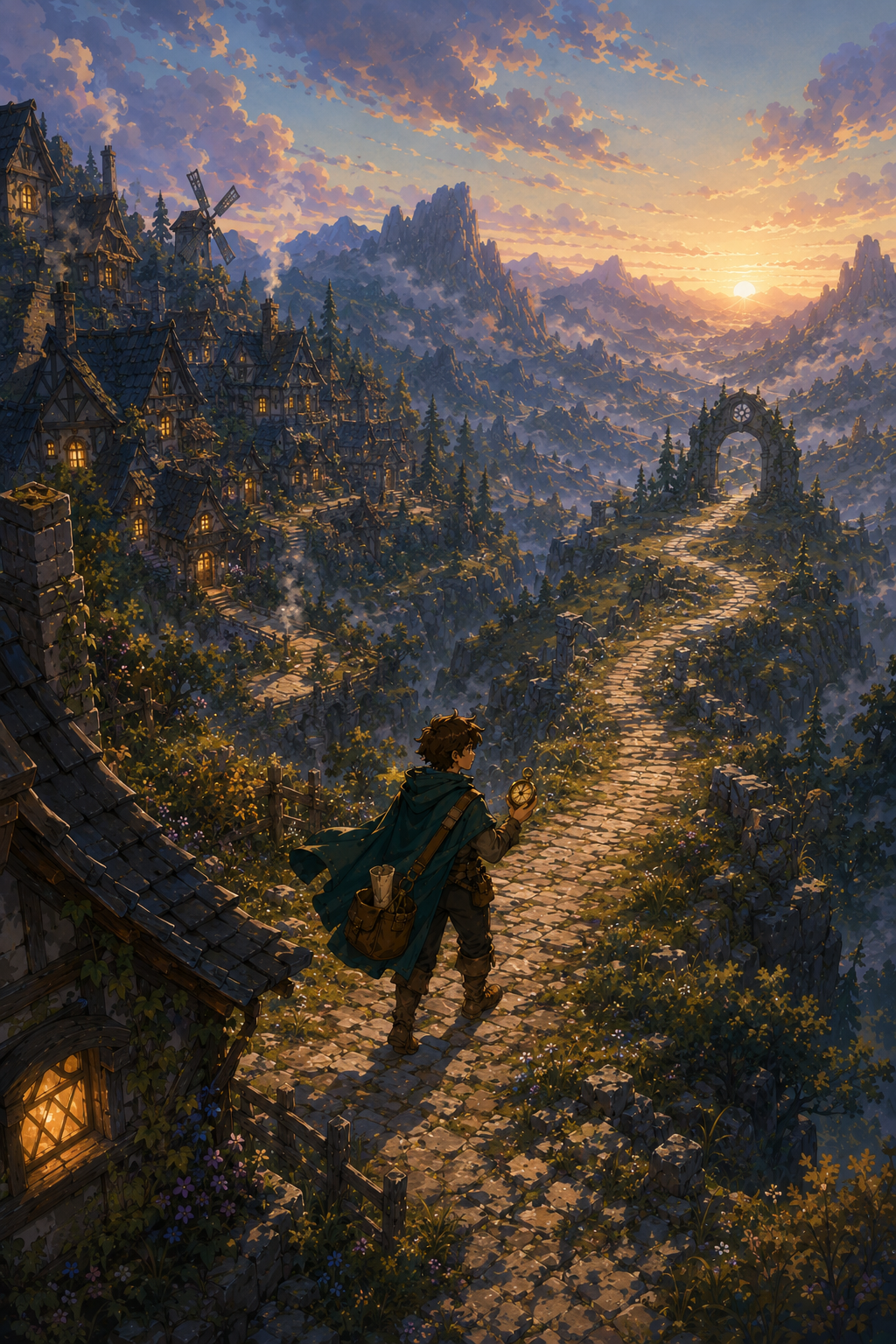
Every clue points north. Three forgotten roads leave Maculara and meet beneath the ridge: one through the Whispering Forest, one past the ruined watchtower, and one beside the underground river.
The cleric gives you rope, chalk, bandages, and the village records. She asks you to guard the records carefully, since the names and vision changes inside them will help match the treasure to each villager if you return.
Before sunrise, you pass the final farmhouse and follow the bronze compass toward the three-road crossing.