









Ever wonder why your natural instinct is to squint when something looks blurry? Why does squinting make the image clearer? And how do your eyes know to do it?
Squinting is a common reflex, even among people who normally see clearly. The reason it works comes down to how light enters the eyes.
Narrowing your eyelids briefly blocks some of the scattered light that would otherwise reach the retina, making the image appear sharper. That small improvement can reveal clues about your eyesight, including whether you have an uncorrected refractive error. However, you can’t exactly spend your whole life squinting to see. When blurry vision becomes a regular problem, an eye exam and proper vision correction can help you see clearly without the constant strain.
In This Guide
How Does Squinting Make Your Vision Clearer
To see clearly, light must enter through the cornea and pupil before the lens focuses it onto the retina at the back of the eye. When the eye focuses light correctly, it forms a sharp image. A refractive error can cause some light rays to land in front of, behind, or unevenly on the retina, making your vision look blurry.
Squinting creates what’s known as the pinhole effect where you look through a very small opening to limit the amount and direction of light entering your eye.
The opening blocks some of the scattered or angled light rays and lets a narrower beam travel toward the retina. Since fewer misdirected rays reach the retina, the image can appear sharper.
A smaller opening also increases depth of focus, which means objects across a wider range of distances can remain relatively clear. This is why letting in less light can sometimes improve clarity, even though it makes the image dimmer.
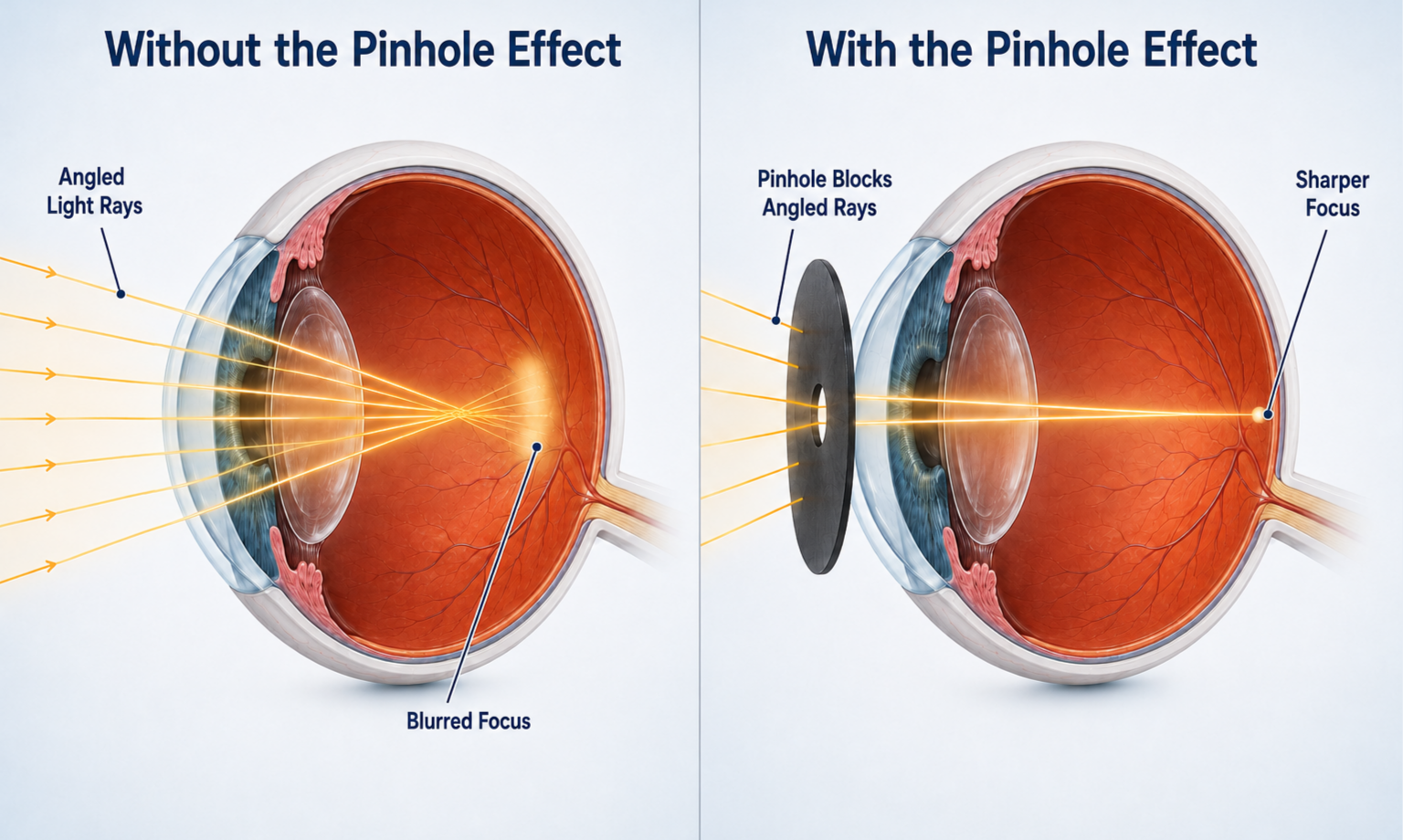
You can try the effect by making a tiny opening with your fingers and looking through it at something blurry. The object can suddenly appear clearer, but your eyesight hasn’t changed. You’ve temporarily changed the path of the light entering your eye.
Just like an eye chart, narrowing the opening sharpens the image. This is the same effect as the finger trick above, on a loop.
Eye doctors apply the same principle during a pinhole test. A patient looks at an eye chart through a small opening to see whether the blur improves. Clearer vision through the pinhole can suggest that a refractive error is contributing to the problem, though the test alone can’t diagnose the cause.
What Vision Problems Can Improve When You Squint?
When squinting gives you clearer vision, it usually points to a refractive error. This means the shape of the eye prevents incoming light from focusing directly on the retina. Squinting doesn’t correct that error, but it can temporarily reduce some of the blur it creates.
Nearsightedness
Distant objects look blurry because light focuses in front of the retina. Squinting blocks angled light rays and narrows the beam entering the eye, so distant signs, faces, or screens can briefly look sharper.
Farsightedness
Light focuses behind the retina, which can make nearby objects harder to see. Squinting increases depth of focus, which can make close details appear somewhat clearer for a short time.
Astigmatism
An irregular corneal or lens curve causes light to focus unevenly. Narrowing the eyelids creates a slit-like opening that can reduce blur in one direction, depending on the astigmatism’s orientation.
Outdated Prescription
Needing to squint while wearing glasses or contacts can mean your prescription has changed. Squinting temporarily compensates for the remaining blur, but it doesn’t make your current prescription work better.
Seeing more clearly while squinting suggests that a focusing error could be contributing to blurry vision. However, this can’t tell you whether you have nearsightedness, farsightedness, astigmatism, or a prescription change. Only an eye exam can identify the cause and determine the right correction.
Is Squinting Bad for Your Eyes?
Occasional squinting won’t permanently damage your eyes or make your eyesight worse. It’s a natural response to blurry vision or bright light. Once you relax your eyelids, your vision returns to how it was before you squinted.
What we don’t recommend is squinting for long periods. Keeping the muscles around your eyes and forehead tense can become uncomfortable and contribute to eye fatigue, facial tension, or headaches. These symptoms come from holding that strained expression, not from permanent changes inside the eyes.
Take frequent squinting as a warning sign rather than a cause of poor eyesight. It can mean that your eyes aren’t focusing clearly because of an uncorrected refractive error, an outdated prescription, or another vision issue. Squinting doesn’t create these problems, but it can draw attention to one that’s already present.
Myth vs. Fact
The idea that squinting permanently worsens eyesight is a myth. It can temporarily mask blur, but it can’t change the shape of your eyes or alter your refractive error. When squinting becomes a regular habit, we highly suggest you take an eye exam to find out why seeing clearly takes so much effort.
Squinting Isn’t a Substitute for Vision Correction
Squinting changes the path of light entering your eyes, but it doesn’t correct the reason your vision looks blurry. For clearer vision throughout the day, you can wear prescription glasses or contact lenses. Both bend incoming light so it focuses on the retina instead of in front of, behind, or unevenly across it.
Trouble seeing distant objects is common, but it isn’t something you have to accept as normal. It can affect your ability to read signs, recognize faces, follow a presentation, watch television, or see clearly while driving.
Glasses place corrective lenses a short distance in front of your eyes. Their curves and prescription power redirect incoming light before it reaches the cornea. Single-vision glasses correct one viewing range, while bifocals and progressive lenses contain different powers for seeing at more than one distance.
Contact lenses work through the same basic optical principle, but they rest on the tear film covering the cornea. Different contact lens designs correct different refractive errors:
Spherical
Corrects nearsightedness or farsightedness by moving the focal point onto the retina.
Toric
Corrects astigmatism with different powers across the lens, designed to stay positioned correctly on the eye.
Multifocal
Contains more than one corrective power to help people with presbyopia see at near, intermediate, and far distances.
Some people prefer glasses, while others prefer contacts or switch between both. Your eye doctor can determine which choices suit your prescription, eye health, and daily routine.
Do remember that glasses and contact lenses require separate prescriptions. A contact lens prescription contains fitting details that an eyeglass prescription doesn’t, such as the lens brand, base curve, and diameter. If you’re thinking of getting contact lenses, you can get them right here at VisionPros for discounted prices.
Find Your Perfect Pair
Style meets clarity, starting online. Shop hundreds of contact lens options from trusted brands, all at affordable prices.
Shop Contact Lenses →When Should You See an Eye Doctor About Blurry Vision?
Blurry vision doesn’t always signal a lasting eyesight problem. Your vision can briefly lose focus after hours of reading or screen use. Dryness can also disturb the tear film on the eye, causing blur that clears after you blink or rest. However, recurring or unexplained changes still deserve attention.
- You frequently squint to read signs, screens, books, or classroom materials
- Your eyes feel tired, or you develop headaches after visual tasks
- You struggle to see clearly while driving, especially at night
- Your near or distance vision has gradually changed
- Your glasses or contacts no longer feel as clear as they once did
- Temporary blur keeps returning, even when it clears after blinking or resting
- Sudden blurry vision
- Eye pain
- A sudden increase in floaters
- Flashes of light
- A dark curtain or shadow in your vision
- Partial or complete vision loss
These symptoms can signal eye injuries, inflammation, retinal tears, or retinal detachment. If this happens, don’t wait for a routine appointment.
Your Eyes Deserve a Clearer View
Your eyes do a lot for you, but squinting was never meant to be their full-time job. Clear vision should feel natural, not like something you have to force into focus.
Give your eyes the attention they’re asking for by booking an eye exam when squinting becomes a habit or blurry vision keeps returning. Once you have an updated contact lens prescription, let VisionPros help you find the exact lenses your eye doctor prescribed so you can see the world with less effort and a much clearer view.

Frequently Asked Questions
References
Refractive Errors. National Eye Institute. nei.nih.gov. Updated December 19, 2025. Accessed August 19, 2026.
Types of Refractive Errors. National Eye Institute. nei.nih.gov. Updated September 4, 2025. Accessed August 19, 2026.
Pinhole Visual Acuity. American Academy of Ophthalmology. aao.org. Accessed August 19, 2026.
Eyelid Squinting Improves Near Vision in Against-the-Rule and Distance Vision in With-the-Rule Astigmatism in Pseudophakic Eyes. Rhim JW, Eom Y, Park SY, et al. BMC Ophthalmology. pmc.ncbi.nlm.nih.gov. Published January 2, 2020. Accessed August 19, 2026.
Eyeglasses for Refractive Errors. National Eye Institute. nei.nih.gov. Updated July 8, 2019. Accessed August 19, 2026.
Contact Lenses. National Eye Institute. nei.nih.gov. Updated December 5, 2024. Accessed August 19, 2026.
About Contact Lens Types. Centers for Disease Control and Prevention. cdc.gov. Updated May 27, 2025. Accessed August 19, 2026.
Digital Devices and Your Eyes. American Academy of Ophthalmology. aao.org. Updated December 5, 2025. Accessed August 19, 2026.
How Do I Know I Need to Visit the Optometrist? American Optometric Association. aoa.org. Updated November 19, 2024. Accessed August 19, 2026.
Retinal Detachment. National Eye Institute. nei.nih.gov. Updated November 5, 2025. Accessed August 19, 2026.