








Picture this: You spend a bright afternoon at the beach, on a boat, or hiking through the snow. Everything feels fine when you head home. Then, several hours later, your eyes begin to burn. They turn red and watery, light suddenly feels unbearable, and blinking feels as though someone sprinkled sand beneath your eyelids.
What happened? Your eyes might be sunburned.
The medical name for this condition is photokeratitis, a painful injury caused by too much exposure to ultraviolet (UV) radiation. Much like a sunburn damages the surface of your skin, photokeratitis damages the exposed surface of your eyes. The condition is usually temporary, but that doesn’t make it harmless or pleasant.
Can Your Eyes Really Get Sunburned?
Yes, although the word “sunburn” is a comparison rather than a description of your eye turning pink like sunburned skin.
Photokeratitis mainly affects the cornea, the clear, curved surface covering the front of your eye, and the conjunctiva, the thin membrane covering the white part of your eye and the inner eyelids. These tissues are directly exposed to light, so they can absorb damaging UV radiation when your eyes aren’t properly protected.
Think of the cornea as your eye’s transparent front window. It helps focus incoming light while shielding the delicate structures behind it. After a strong dose of UV radiation, cells on that window can become damaged and begin shedding. That process can trigger considerable pain, tearing, swelling, and sensitivity to light.
What Causes Photokeratitis?
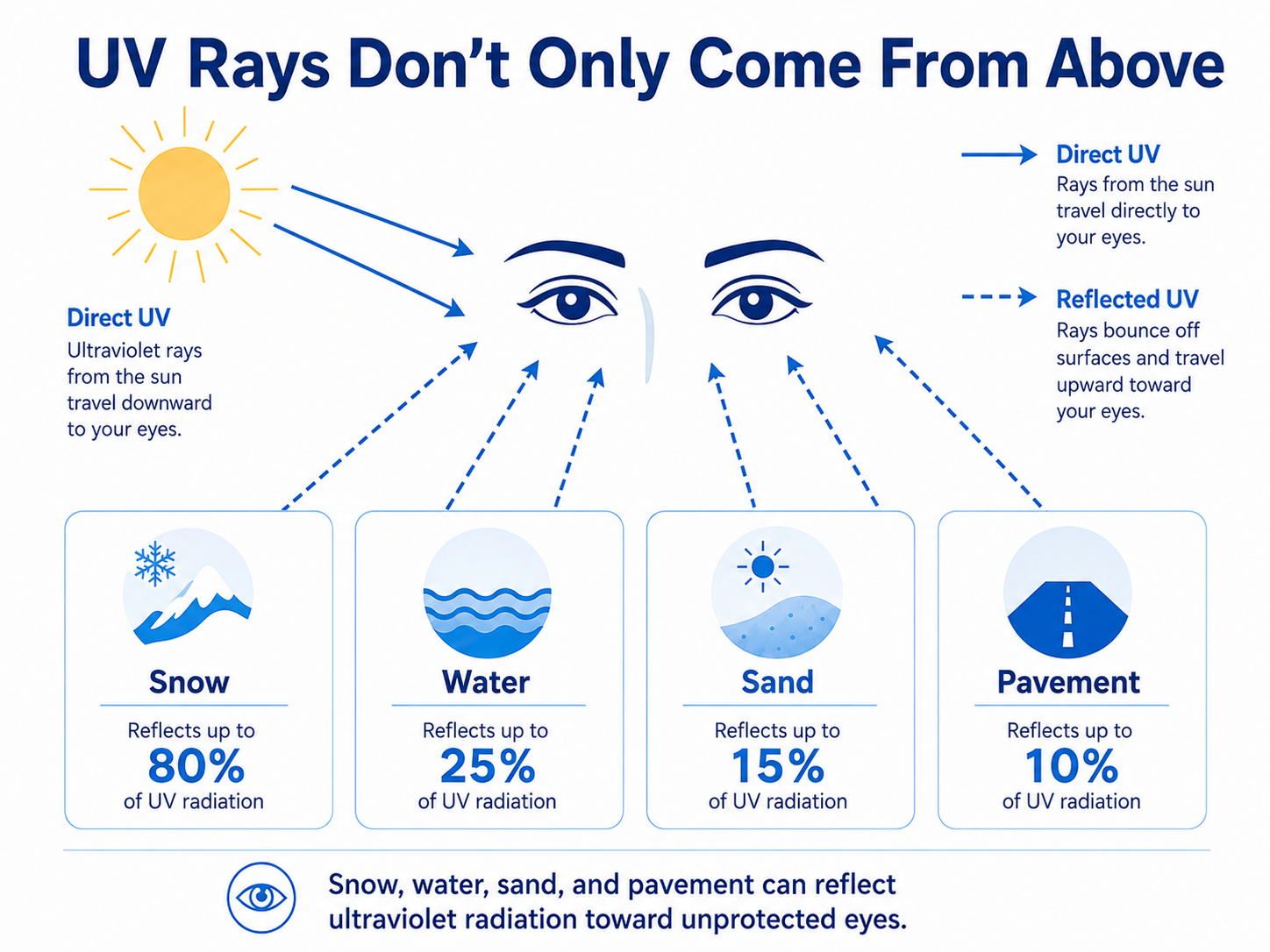
The sun is the most familiar source, but direct sunlight isn’t the only way UV rays reach your eyes. Light can bounce off reflective surfaces and approach your eyes from below or from the side. Snow, ice, water, sand, pavement, and concrete can all reflect UV radiation. That means photokeratitis can happen during a day at the beach, a fishing trip, a mountain hike, or an afternoon spent skiing.
Snow-related photokeratitis is commonly called snow blindness. The name sounds dramatic, but it describes a real risk. Snow and ice reflect sunlight toward the eyes, while higher elevations can expose people to stronger UV levels. Skiers, snowboarders, mountain climbers, and hikers can experience eye damage even when the air feels cold and the sky looks cloudy.
Artificial sources can cause the condition as well. These include welding arcs, tanning beds and sunlamps, UV sterilizing equipment, certain medical lamps, damaged high-intensity halogen lights, and other equipment that produces concentrated UV radiation.
Photokeratitis caused by welding is sometimes called welder’s flash or arc eye. Proper occupational eye protection is necessary because the injury can occur without a person staring directly at the light source.
What Do Sunburned Eyes Feel Like?
Photokeratitis can produce symptoms in one or both eyes, although both eyes are commonly affected after outdoor UV exposure. Possible symptoms include:
- Burning or intense eye pain
- Redness
- Watery eyes
- Swollen eyelids
- Blurry or hazy vision
- Strong sensitivity to light
- A gritty, sandy feeling in the eye
- Headaches
- Halos around lights
- Eyelid twitching or spasms
- Temporary changes in vision
- Rarely, temporary vision loss
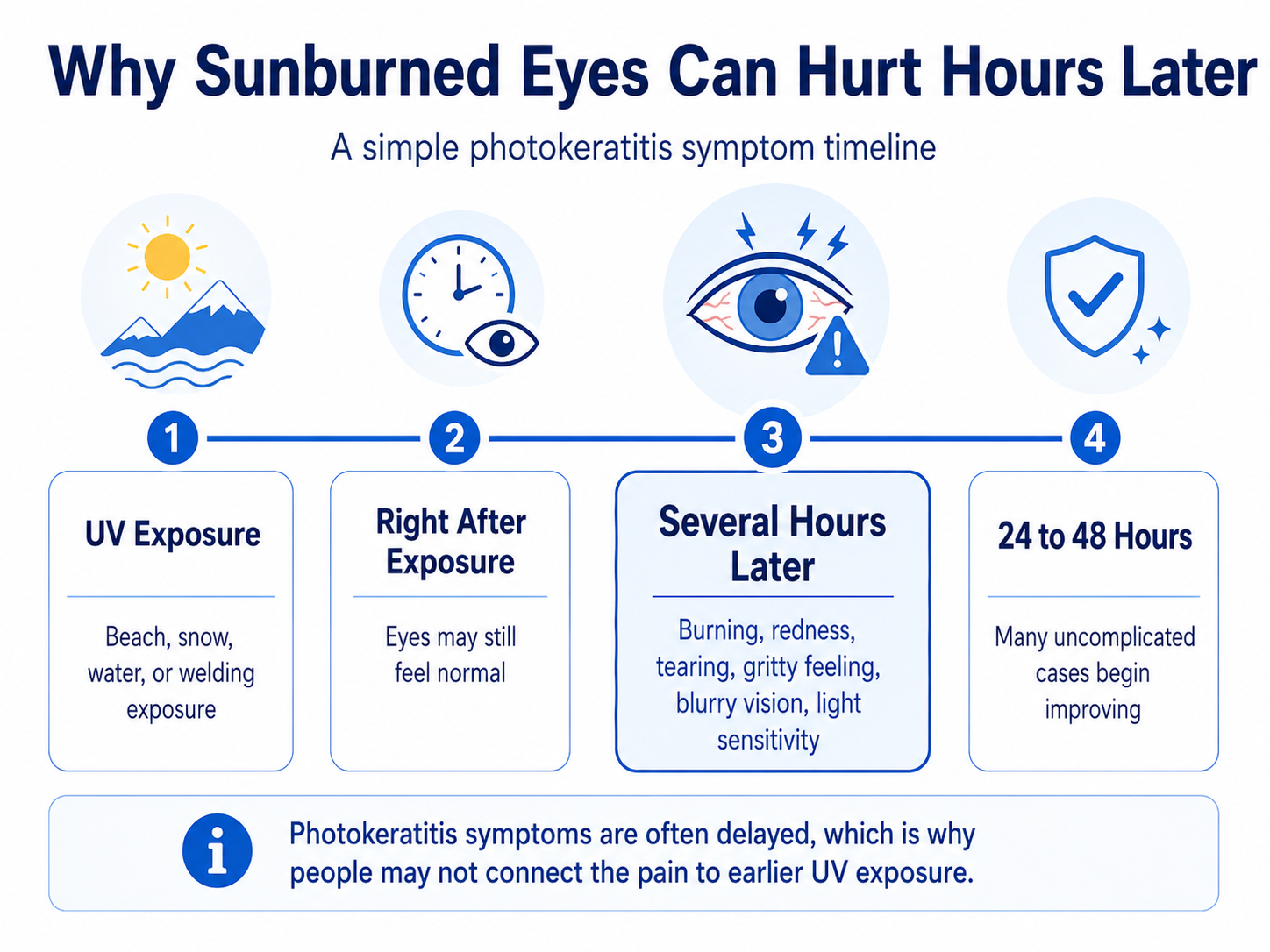
Here’s the tricky part: symptoms don’t always begin while you’re outside. Photokeratitis can have a delayed effect. Your eyes might feel normal immediately after the exposure, with pain and irritation developing several hours later.
That delay is one reason people don’t always connect their symptoms to a sunny afternoon, a welding project, or time spent near reflective snow or water. The severity of the symptoms can depend on the intensity and length of the UV exposure.
Is Photokeratitis the Same as Looking at the Sun?
No. Both involve light damage, but they can affect different parts of the eye.
| Photokeratitis | Solar Retinopathy | |
|---|---|---|
| Damaged area | Cornea | Retina |
| Usual cause | Reflected UV or welding | Looking at the sun |
| Main symptoms | Pain, redness, tearing, light sensitivity | Blind spots, distorted or reduced vision |
| Symptom timing | Commonly delayed | Can begin soon after exposure |
| Recovery | Often improves within 24–48 hours | Can cause lasting vision damage |
| Next step | Remove contacts and rest the eyes | Seek prompt eye care |
Photokeratitis injures the outer surface of the eye, especially the cornea. Looking directly at the sun can damage the retina, the light-sensitive tissue at the back of the eye. That condition is called solar retinopathy, and it can lead to lasting blind spots or reduced central vision. Never look directly at the sun, including during a solar eclipse, without certified eclipse-viewing protection.
Vision changes after looking at the sun require prompt examination by an eye care professional.
What Should You Do When Your Eyes Feel Sunburned?
Move indoors and get away from the UV source. Resting in a dim room can reduce discomfort while your eyes begin recovering.
Contact lens wearers should remove their lenses and leave them out until an eye doctor says it’s safe to wear them again. Avoid rubbing your eyes, since rubbing can further irritate an already damaged surface.
A cool, clean compress placed over closed eyelids can provide relief. Preservative-free artificial tears can also help soothe irritation for some people. Sunglasses may make indoor or outdoor light more tolerable during recovery. An eye care provider can recommend appropriate pain relief or prescribe medication when needed.
Don’t place leftover prescription drops, numbing drops, or another person’s medication in your eyes. The correct treatment depends on the cause and severity of the injury.
Most uncomplicated cases improve within 24 to 48 hours as the corneal surface repairs itself. Still, eye pain and blurry vision can have many causes, including infection, a corneal scratch, or inflammation inside the eye. An examination is the safest way to confirm what’s happening.
When Should You Contact an Eye Doctor?
Contact an optometrist, ophthalmologist, or another medical professional after suspected UV exposure when you experience significant eye pain, light sensitivity, or changes in vision. Seek prompt medical attention when:
- Vision suddenly decreases or disappears
- Pain is severe or continues to worsen
- Symptoms last longer than one or two days
- Only one eye has significant pain
- You notice pus-like discharge
- Something may be stuck in the eye
- The exposure involved chemicals, heat, or an explosion
- Symptoms began after staring directly at the sun
- You can’t comfortably open your eyes
An eye care professional can examine the cornea using magnification and a dye called fluorescein. The dye highlights areas of surface damage and helps the provider distinguish photokeratitis from other eye injuries.
How Can You Prevent Photokeratitis?
The easiest sunburn to treat is the one that never happens.
Choose sunglasses labeled as blocking 99% to 100% of UVA and UVB radiation or providing UV400 protection. The color or darkness of the lenses doesn’t reliably show how much UV protection they provide, so check the label rather than judging the tint.
Wraparound frames provide additional coverage by reducing the amount of light that reaches your eyes from the sides. Pairing sunglasses with a wide-brimmed hat gives your eyes another layer of shade. Goggles designed for skiing and snow sports should also provide strong UV protection.
Keep your sunglasses on near water, snow, sand, and other reflective surfaces. Clouds don’t eliminate UV exposure, so eye protection still belongs in your routine on bright overcast days. Children need UV-blocking sunglasses as well because their eyes can also be damaged by ultraviolet radiation.
People working around welding equipment, UV lamps, or industrial light sources should use protective eyewear made for that exact job. Regular sunglasses aren’t designed to replace certified occupational safety equipment.
Do UV-Blocking Contact Lenses Replace Sunglasses?
Some contact lenses include UV-blocking features, but they don’t cover the entire eye or the skin surrounding it. They should be treated as an additional layer of protection rather than a substitute for UV-blocking sunglasses.
This point is easy to miss. A contact lens sits over the cornea, while UV rays can still reach the conjunctiva, eyelids, and surrounding tissues. Wearing quality sunglasses over your contact lenses provides broader coverage.
Most people wouldn’t spend hours under strong sunlight without thinking about sunscreen. Your eyes deserve the same level of attention.
Photokeratitis can arrive quietly, with symptoms appearing hours after the UV exposure has ended. Fortunately, a pair of properly labeled sunglasses, a hat, and activity-specific protective eyewear can greatly reduce the risk. So before heading to the beach, the mountains, the lake, or a sunny outdoor event, remember one simple rule: protect the parts of your body that can’t apply their own sunscreen. Your eyes will thank you.
Your eye care destination
Everything your eyes
need, all in one place.
Shop top brands in contact lenses and sunglasses — all at trusted low prices.
Shop VisionPros →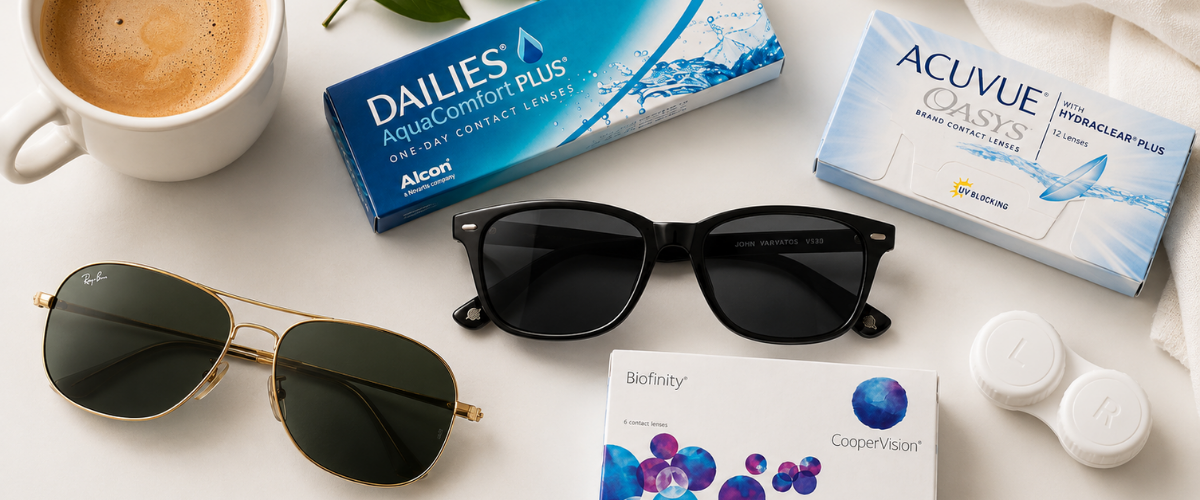
References
- Photokeratitis. Cleveland Clinic. https://my.clevelandclinic.org/health/diseases/15763-photokeratitis. Last reviewed November 7, 2023.
- What Is Photokeratitis, Including Snow Blindness? American Academy of Ophthalmology. https://www.aao.org/eye-health/diseases/photokeratitis-snow-blindness. Updated June 30, 2026.
- Photokeratitis Induced by Ultraviolet Radiation in Travelers. Izadi M, Jonaidi-Jafari N, Pourazizi M, Alemzadeh-Ansari MH, Hoseinpourfard MJ. Journal of Postgraduate Medicine. https://pmc.ncbi.nlm.nih.gov/articles/PMC5820813/. Published 2018.
- How to Watch an Eclipse, Safely. National Eye Institute. https://www.nei.nih.gov/research-and-training/research-news/how-watch-eclipse-safely. Published March 26, 2024.
- Solar Retinopathy: Symptoms, Causes & Recovery. Cleveland Clinic. https://my.clevelandclinic.org/health/diseases/solar-retinopathy. Last reviewed March 7, 2024.
- Protecting Your Eyes From the Sun’s UV Light. National Eye Institute. https://www.nei.nih.gov/research-and-training/research-news/protecting-your-eyes-suns-uv-light. Published July 5, 2022.
- Radiation: Ultraviolet (UV) Radiation. World Health Organization. https://www.who.int/news-room/questions-and-answers/item/radiation-ultraviolet-%28uv%29. Published March 9, 2016.
- Ultraviolet (UV) Protection. American Optometric Association. https://www.aoa.org/healthy-eyes/caring-for-your-eyes/uv-protection. Accessed August 3, 2026.